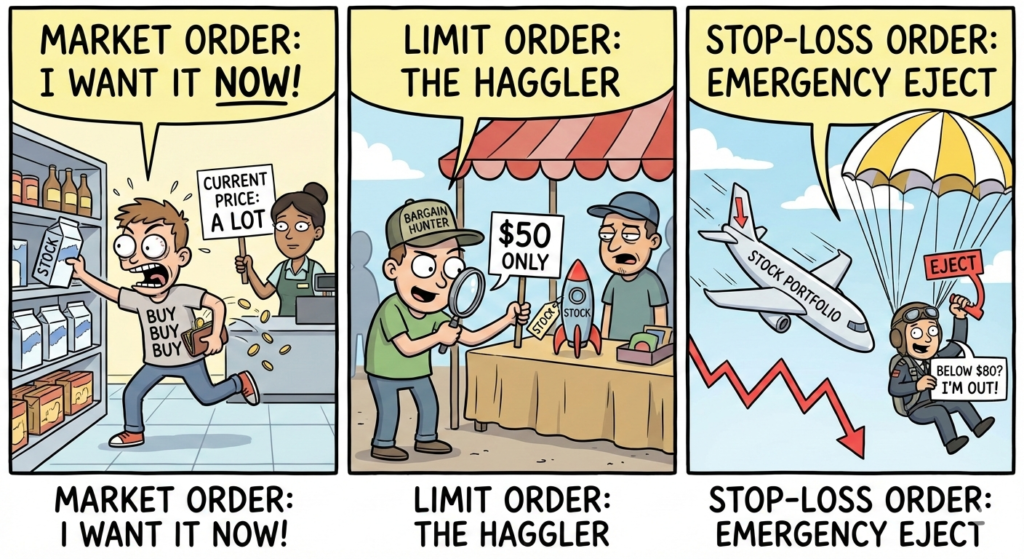
Entering the stock market for the first time feels a lot like walking into a high-end French restaurant when you don’t speak French and you’re pretty sure you’re underdressed. You see a lot of buttons, flashing lights, and numbers moving faster than your heart rate during a cardio class.
Before you accidentally trade your life savings for a collection of obscure dog-themed digital coins, you need to master the three “holy grails” of order types. Think of these as your survival gear for the financial jungle.
1. The Market Order: “I Want It Now”
The Market Order is the equivalent of walking into a grocery store, grabbing a gallon of milk, and shouting, “I don’t care what it costs, just take my money!” It is the most basic way to buy or sell. You are telling the market: “Execute this trade immediately at the best available current price.”
The Vibe: Extreme impatience.
The Pro: You are guaranteed to get the stock. It’s fast, efficient, and great for when a stock is mooning and you’re terrified of being left behind.
The Con: “Slippage.” If the market is moving fast, you might click “Buy” at $100, but by the time the computer processes your frantic clicking, you’ve actually paid $102. Congratulations, you just paid a convenience fee you didn’t ask for.
2. The Limit Order: “The Haggler”
If the Market Order is a frantic shopper, the Limit Order is that person at the flea market who refuses to pay a penny over their target price. With a Limit Order, you set a maximum purchase price (for buying) or a minimum sale price (for selling).1
| Feature | Buy Limit | Sell Limit |
| Your Command | “Buy only if it drops to $X or lower.” | “Sell only if it rises to $Y or higher.” |
| Risk | The price never hits your target, and you get nothing. | You miss out on further gains if the stock keeps soaring. |
This is for the disciplined investor. You’ve done your homework, you know what the stock is worth, and you’re willing to wait. The downside? If the stock price misses your limit by a single cent before skyrocketing to the moon, you’ll be left standing on the launchpad holding nothing but your dignity and an empty brokerage account.
3. The Stop-Loss Order: “The Emergency Eject”
The Stop-Loss Order is arguably the most important tool in your kit because it prevents “I’m just investing for fun” from turning into “I’m eating ramen for the next three years.”
It’s an automated instruction to sell your stock if the price drops to a certain level. Think of it as a pre-planned breakup. You’re telling the stock: “I love you, but if you drop below $80, we are done. I’m moving out and taking the cat.”
Why use it? It removes the “emotional” factor. Most humans have a hard time admitting they’re wrong. A Stop-Loss doesn’t have feelings; it just executes the exit so you don’t ride a sinking ship all the way to the bottom of the ocean.2
Summary: Which one should you use?
Use a Market Order if you need to get in or out right this second and don’t mind a small price surprise.
Use a Limit Order if you are a bargain hunter who demands a specific price.
Use a Stop-Loss Order if you enjoy sleeping at night without worrying that a midnight market crash will wipe you out.
Mastering these won’t make you an overnight billionaire, but it will keep you from being the person who accidentally buys the top and sells the bottom. Happy trading!
Would you like me to create a sample “trading plan” template that incorporates these three order types for a hypothetical stock?