Imagine you’re at a flea market. You see a vintage, slightly creepy porcelain doll. You think, “I’d pay $20 for that.” That is the Bid. The seller, who clearly values their nightmares more than you do, says, “I won’t take a cent less than $30.” That is the Ask.
In the world of trading, that $10 gap is the Bid-Ask Spread. It’s the “hidden cost” that makes your wallet cry before you’ve even walked away with your haunted doll.
1. The Bid-Ask Spread: The Financial “Tug-of-War”
When you look at a stock ticker and see a single price, like $150.00, that’s just the “last traded price.” In reality, there is always a secret dance happening behind the scenes:
The Bid: The highest price someone is currently willing to pay to buy the asset. (The “Lowballer”).
The Ask: The lowest price someone is currently willing to accept to sell the asset. (The “Optimist”).
The spread is the difference between them. If you buy a stock and immediately sell it back a second later, you will lose money because you bought at the higher Ask and sold at the lower Bid. This is the market’s way of charging you a “convenience tax” for participating.
2. Liquidity: The Difference Between a Party and a Desert Island
Liquidity is simply how fast you can turn an asset into cold, hard cash without getting “fleeced” on the price.
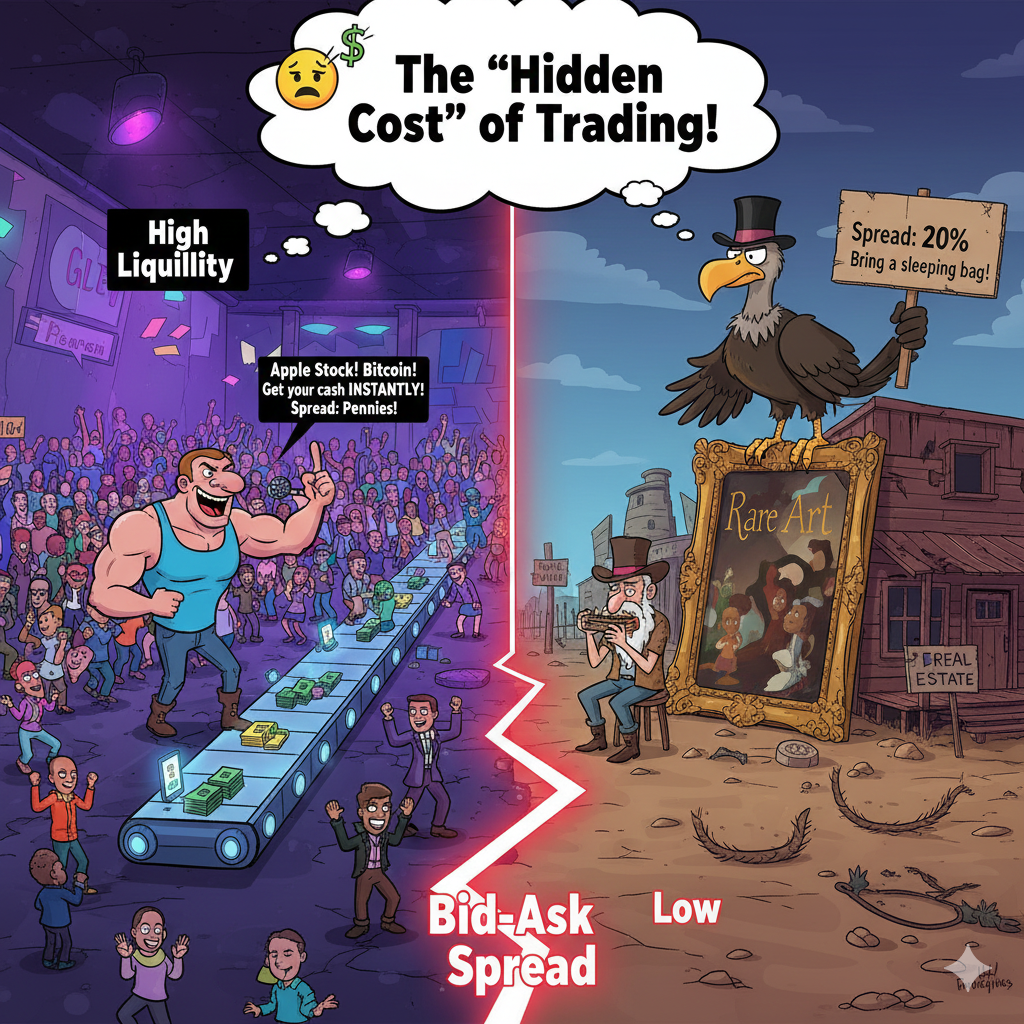
High Liquidity (The Nightclub): Think of Apple stock or Bitcoin. There are millions of people shouting “Buy!” and “Sell!” at the same time. Because there are so many people, the Bid and Ask are usually fractions of a penny apart. You can exit your position in milliseconds.
Low Liquidity (The Ghost Town): Think of a rare 1990s Beanie Baby or Real Estate. If you want to sell your house today, you’d have to drop the price significantly. There isn’t a line of people around the block waiting to buy your 3-bedroom ranch at 2:00 AM.
Quick Comparison: Liquidity Styles
| Feature | Highly Liquid (e.g., S&P 500) | Illiquid (e.g., Rare Art) |
| Spread | Razor-thin (pennies) | Wide (could be 10-20%+) |
| Speed | Instant | Bring a sleeping bag |
| Price Stability | High | One big trade can break everything |
| Vibe | Busy stock exchange | A dusty attic |
3. Why This “Hidden Cost” Matters
If you are trading “penny stocks” or obscure crypto coins with the liquidity of a dried-up raisin, the spread can be 5% or even 10%.
Example: You buy $1,000 of “MoonCorgiCoin.” The spread is 10%. The moment you click “Buy,” your investment is worth $900. You need the coin to go up 11% just to break even and see $0 profit. That’s the “hidden cost” eating your lunch.
Market makers—the middlemen who facilitate these trades—live inside that spread. They buy from the seller at the Bid and sell to the buyer at the Ask, pocketing the difference. They aren’t evil; they’re just the people making sure there’s actually a party to go to, even if they charge a cover fee at the door.
Summary
The more people trading an asset, the tighter the spread and the easier it is to move your money around. Always check the spread before you hit “Trade,” or you might find yourself stuck with a digital porcelain doll nobody wants to buy.
Would you like me to explain how “Limit Orders” can help you avoid paying the full spread on your next trade?