Price Action Entries (Whenever these patterns shows up at "right levels" it could be a good place to Enter the market)
- 1
- 2
The Glamorous Life of "Stuff": A Professional Look at Commodities
In the sophisticated world of global finance, we often spend our time obsessing over complex algorithms, high-frequency trading, and intangible derivatives. But occasionally, it’s healthy to remember that the entire global economy is essentially just a very high-stakes game of moving heavy things from Point A to Point B.
Welcome to the world of commodities: the raw materials that prove, no matter how digital we become, humans still really like fire, shiny metal, and snacks.
The Executive Summary (The “TL;DR”)
At its core, cryptocurrency is decentralized digital money. It uses a technology called blockchain—which is essentially a shared digital ledger that everyone can see but no one can secretly edit.
Think of it like a public group chat where everyone records who owes whom for pizza, except the chat is encrypted by supercomputers and worth $2 trillion.
The Major Players
Bitcoin (BTC): The “Digital Gold.” It’s the elder statesman of the group. It’s slow, it’s expensive, and everyone’s dad is finally starting to ask if they should buy some.
Ethereum (ETH): The “World Computer.” It doesn’t just move money; it runs “smart contracts.” It’s basically the internet, if the internet charged you a “gas fee” every time you clicked a button.
Altcoins: This is everything else. It ranges from legitimate technological breakthroughs to coins named after Shiba Inus that were created as a joke but now have market caps larger than major airlines.
Why People Love It (The “Bull Case”)
Financial Sovereignty: You are your own bank. No more waiting three days for a wire transfer because a bank in Ohio decided to take a long weekend.
Scarcity: Unlike the US Dollar, which can be printed whenever a stimulus is needed, most crypto has a hard cap. You can’t just “print” more Bitcoin.
The Tech: We are talking about the future of ownership, transparency, and global finance.
Why People Need Tums (The “Bear Case”)
Volatility: Crypto prices move faster than a teenager’s mood swings. A 10% drop in the stock market is a national tragedy; a 10% drop in crypto is called “Tuesday.”
Security: If you lose your “private keys” (your password), your money is gone. There is no “Forgot Password” button in the decentralized world. There is only sadness.
The Jargon: You’ll have to learn words like HODL, FOMO, and Web3 just to understand why your portfolio is currently down 40%.
Pro-Tip for the Aspiring Investor
Rule Number One: Never invest more than you can afford to lose. If the thought of your investment “going to the moon” or “sinking to the bottom of the Mariana Trench” keeps you up at night, stick to index funds.
Crypto is a wild ride. It’s a mix of revolutionary philosophy, brilliant math, and absolute madness. Approach it with a curious mind, a cold heart, and a very secure password.
Technical Analysis vs. Fundamental Analysis: The Great Market Debate
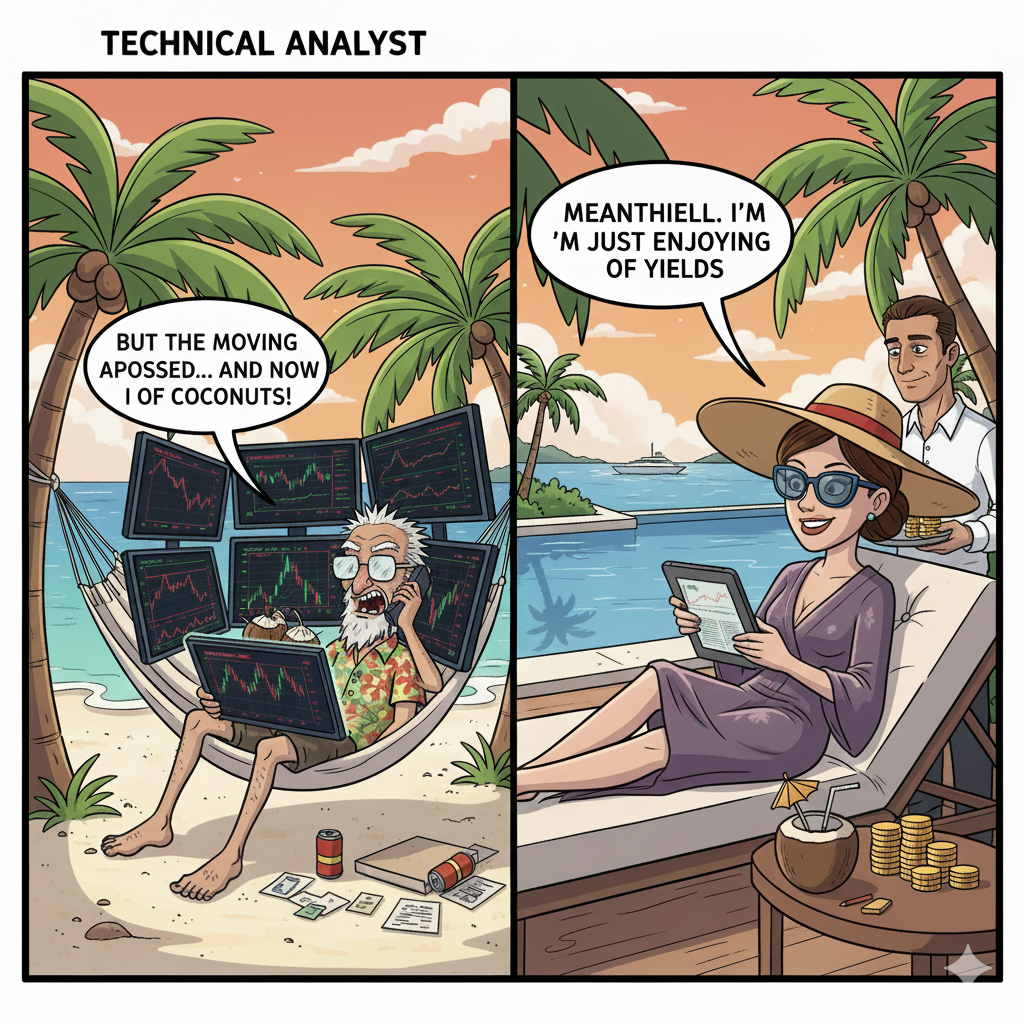
When it comes to figuring out if a currency (or stock, or commodity, or your neighbour’s questionable collection of garden gnomes) is going to go up or down, investors generally fall into two warring camps: Technical Analysts and Fundamental Analysts. It’s the classic battle of “What the Chart Says” versus “What the World Is Doing.”
Camp 1: Technical Analysis – The Chart Whisperers
Imagine you’re trying to predict if your cat will knock over that vase again. A Technical Analyst wouldn’t care why the cat does it (too much energy, existential dread, simple malice). They’d just study the cat’s past vase-knocking patterns, look for recurring paw movements, and draw trend lines on a diagram of your living room.
In the financial world, Technical Analysis is the study of past market data, primarily price and volume, to forecast future price movements. It operates on the core belief that “history repeats itself” and that all relevant information is already reflected in the asset’s price.
The Professional Gist: Technical analysts believe market psychology and behavior patterns are observable through charts. They look for:
Trend Lines: Is the market going up (bullish), down (bearish), or sideways (confused)?
Support and Resistance Levels: These are price ceilings and floors that the market often respects. Think of them as invisible force fields that prices struggle to break through.
Chart Patterns: Head and Shoulders, Double Tops, Triangles… sounds like a yoga class, but these are specific formations that suggest future price direction.
Indicators: Moving Averages, RSI, MACD. These are mathematical calculations based on price and volume, designed to tell you if something is “overbought” (too popular) or “oversold” (nobody wants it, yet).
The beauty of technical analysis is its universality. You can use it on pretty much anything with a price chart. The downside? Sometimes the market decides to spontaneously combust, ignoring all your carefully drawn squiggles.
Lorem ipsum dolor sit amet, consectetur adipiscing elit. Ut elit tellus, luctus nec ullamcorper mattis, pulvinar dapibus leo.
Camp 2: Fundamental Analysis – The News Junkies & Economic Detectives
Now, let’s go back to the cat and the vase. A Fundamental Analyst would ignore the cat’s past behaviour entirely. Instead, they’d focus on why the cat might knock over the vase. Is it hungry? Is its litter box dirty? Did it just watch a documentary on structural engineering and now feels compelled to test the limits of pottery?
In finance, Fundamental Analysis involves evaluating an asset’s intrinsic value by examining economic, financial, and other qualitative and quantitative factors. It’s about looking at the “big picture” and understanding the underlying health and prospects of an economy, company, or currency.
The Professional Gist: Fundamental analysts are economists, journalists, and sometimes fortune-tellers, trying to predict the future based on:
-
Economic Indicators: GDP reports, inflation rates, interest rate decisions by central banks, unemployment figures. (Is the economy a roaring tiger or a whimpering kitten?)
-
Geopolitical Events: Wars, elections, trade agreements, pandemics. (Did that obscure politician just tweet something that will tank the Yen?)
-
Company Performance (for stocks): Earnings reports, revenue growth, debt levels. (Is this company a money-making machine or just a well-decorated dumpster fire?)
-
Commodity Prices: Oil, gold, agricultural products. (If corn prices skyrocket, how does that affect the Canadian Dollar?)
The goal is to determine if an asset is currently undervalued or overvalued by the market. If your research suggests a currency is fundamentally strong but currently trading low, you might buy it, patiently waiting for the market to “catch up” to its true worth.

Price Action Entries (Whenever these patterns shows up at "right levels" it could be a good place to Enter the market)
- 1
- 2